A framework for ABA supervisors
PACT: Walk into supervising prepared, walk out feeling good about what just happened.
The ten minutes before the meeting matter more than most supervisors realize.
Why this matters
Be the supervisor who walks in confident and with a clear plan.
When a supervisor fails to prepare, the meeting drifts toward whatever feels most urgent in the moment. A client issue takes over. A scheduling problem eats the hour. The supervisee leaves without any clearer sense of where they're headed or whether their supervisor has a plan for getting them there.
Over time, it produces behavior technicians who never quite make the leap to thinking like analysts, because no one ever held that standard consistently enough for them to internalize it. The relationship erodes, the supervisee stops bringing real problems, the supervisor stops expecting much, both people are going through the motions, and everyone can feel it.
PACT is a preparation framework for the ten minutes before the meeting. It lets you be the way you want to be in a meeting, keeps the relationship at the center, and keeps your supervisee's long-term trajectory in view without stressing over it. And it's yours to use, free, right now.
We are not training technicians. We are training analysts. That is the superpower of ABA professionals: to observe and make decisions in the moment.
Tyra P. Sellers, Ph.D., BCBA-D
The Framework
Ten minutes and four steps designed around developing analysts.
PACT is a framework that serves both as an agenda and as an ongoing assessment. In the page that follows and the worksheet below, you work through the Pre-Game section of the PACT supervision model (P in PACT). Pre-Game is completed before the supervision meeting begins so that when you're in the room with your supervisee you're already oriented, you know what matters today, and you can give your full attention to the person in front of you and the ongoing steps.
This is where supervision begins... when you take ten minutes beforehand to think. Where is this person in their overall understanding or development arc? What did we work on last time, and what came of it? What's the relational temperature between us right now? What do I want to focus on today, and what am I carrying into this room that might get in the way? The Pre-Game worksheet walks you through each of these questions one at a time, so you arrive prepared rather than reactive. It doesn't have to take even as much as 10 minutes if you do some of this at the end of the previous meeting and check to ensure accuracy before the meeting.
The Pre-Game questions you answered solo now become the conversation you have with your supervisee. Assess is not the supervisor handing down a list of targets. It's a collaborative process of building metrics both people believe in. You ask questions that get at what the BT wants to move toward, including their path to becoming a behavior analyst, what it looks like to be a consistent presence for the client they serve, and what might get in the way of that. Measures built together carry a different kind of weight than ones that get handed down.
Once you know what you're measuring, you establish together what it means to meet the standard and what happens when the standard isn't met. This isn't punitive, it's collaboratively formulated and clear. Ambiguity in supervision is its own kind of aversive. When the supervisee knows exactly what success looks like and what the response to performance will be, feedback stops feeling like a surprise and starts feeling like information. Consequence makes the whole system transparent.
This is the step that goes beyond what most performance management frameworks address. Transform is the ongoing work of helping a supervisee internalize a standard so deeply that it stops being something they do because someone is watching and starts being who they are. An analyst doesn't just follow a protocol. An analyst observes, decides, and acts from values. That shift happens through the accumulation of supervision conversations that hold the standard consistent and elevated, take the whole person into account, and consistently connect the work in front of them to what they care about most.
Before You Begin
Start the Pre-Game here.
Before you answer any questions on the worksheet, spend two minutes getting your body ready. In this step we're helping it tell your brain things are okay, no matter what anxious or protective signals your brain is sending. What follows asks something behavior analysis doesn't often make room for: attending to your own physiological state before attending to someone else's. These points represent locations where influential nerve bundles sit close to the surface. Try any combination of the techniques listed below, applied to any of the points shown. There's no wrong order, though they are in a suggested sequence. Two to five minutes of honest attention before you walk through the door.
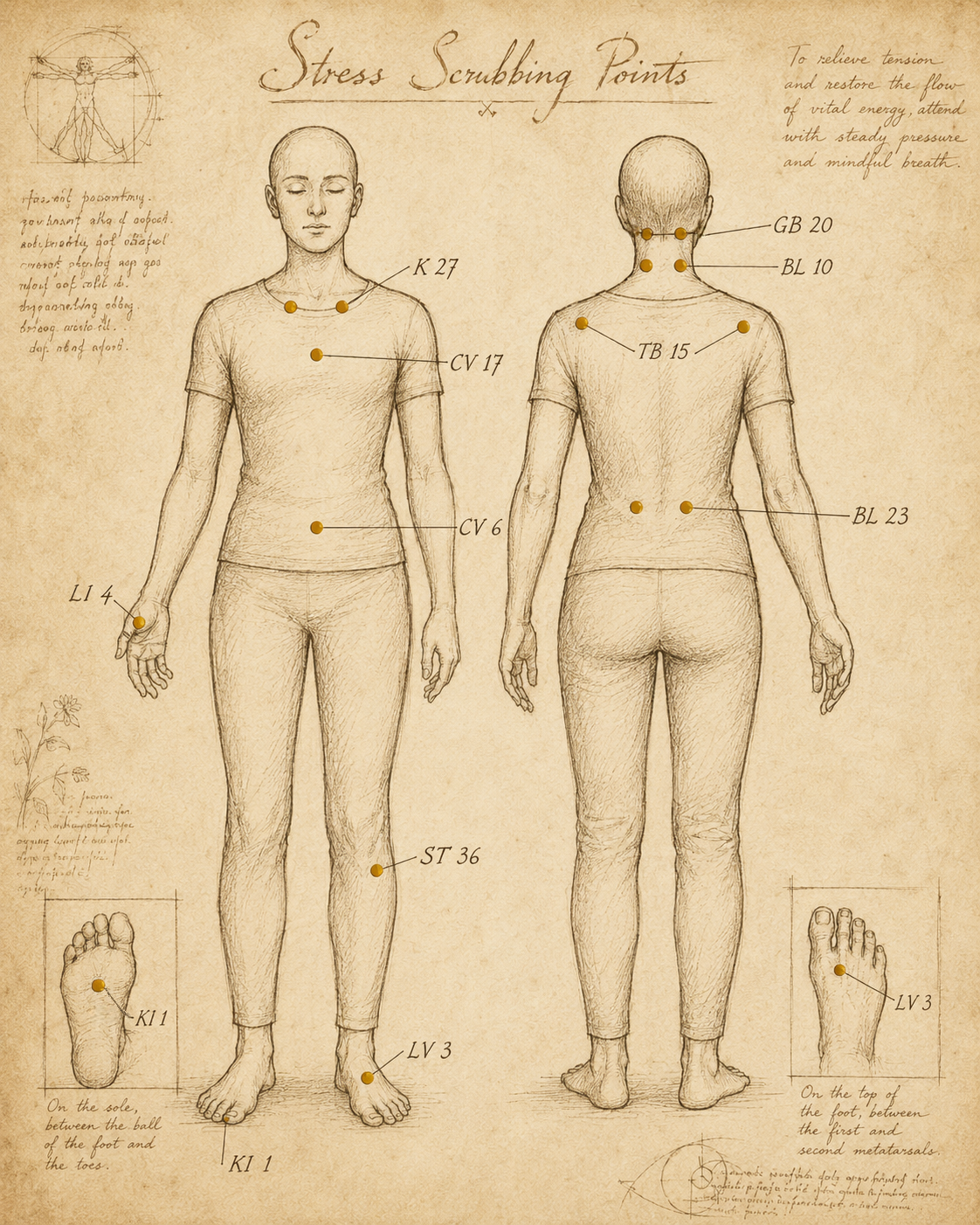
Stress Scrubbing Points • front and back views
Activating techniques tend to increase alertness and energetic tone. Use these when you're feeling flat, foggy, or disconnected before a meeting.
Settling techniques tend to down-regulate arousal and support a sense of groundedness. Use these when you're frustrated, carrying tension from a previous meeting, or feeling anxious about what's coming.
Try any combination of these techniques applied to any of the points shown. Two minutes is enough. You don't need to hit every point. Start with whatever feels most accessible, stay with what produces a noticeable shift, and move on when you're ready. The goal is to arrive in the room with your own physiological state already attended to, so your full attention is available for the person in front of you. Try it some days and not others, and notice whether it changes the way the meeting goes.
Stress Scrubbing protocol derived from Core Centering® and the Somatic Coaching Academy. Used with acknowledgment.
Pre-Game Check
What's the temperature in this relationship right now?
Next you're asked to do something behavior analysis doesn't always make room for: look inward. These aren't pinpoint behaviors, they're pointers toward patterns. Use them as a starting place, not a diagnosis. The goal is honest awareness, not a performance review of yourself.
Emotionally activated in ways that distort the supervision relationship. This might look like over-involvement, reactive when accepting or giving feedback, or rescuing the supervisee from consequences they need to experience. It might also look like frustration leaking into sessions, communication that's frequent but dysregulated in tone, or "Drama Triangle" dynamics cycling between rescuer and villain/critic. Something is running hot, and it's getting in the way.
Present, consistent, making attuned decisions and actions you feel good about later. Communication is purposeful and appropriately frequent. There's warmth without enmeshment, directness without harshness. The supervisee knows where they stand and feels safe enough to bring both struggles and wins. This is where development happens.
Distant, disengaged, passive when asked questions or when challenged. Interpreting comments as challenging. Desire to be right. Communication is sparse or purely transactional. The supervisee may feel invisible, or like supervision is a checkbox being completed. Feedback, when it is given at all, lands without the relationship context it needs to be received well.
Pre-Game Awareness
Where are you showing up right now, and what are you working toward?
These aren't pinpoint behaviors, but they are honest pointers. Behavior analysis has always been better at observing others than observing ourselves, and that's exactly why this step exists. Circle what's true on the left. Let it point you toward what's next on the right.
Stay connected
Get the worksheet. Hear when the CEU launches.
Drop your email below and we'll send you the free PACT Pre-Game worksheet right away, plus a note the moment the Stressed Supervisor CEU Series is ready.
No spam. Just the resources you asked for and the occasional thing worth your time, and you can opt out at any time.
While you're here
Would you like to be an even more influential leader?
The free Inspiring Leadership Scorecard takes a few minutes and gives you a clear picture of where your leadership strengths are and where the most growth is available to you.
Take the Free Inspiring Leadership Scorecard